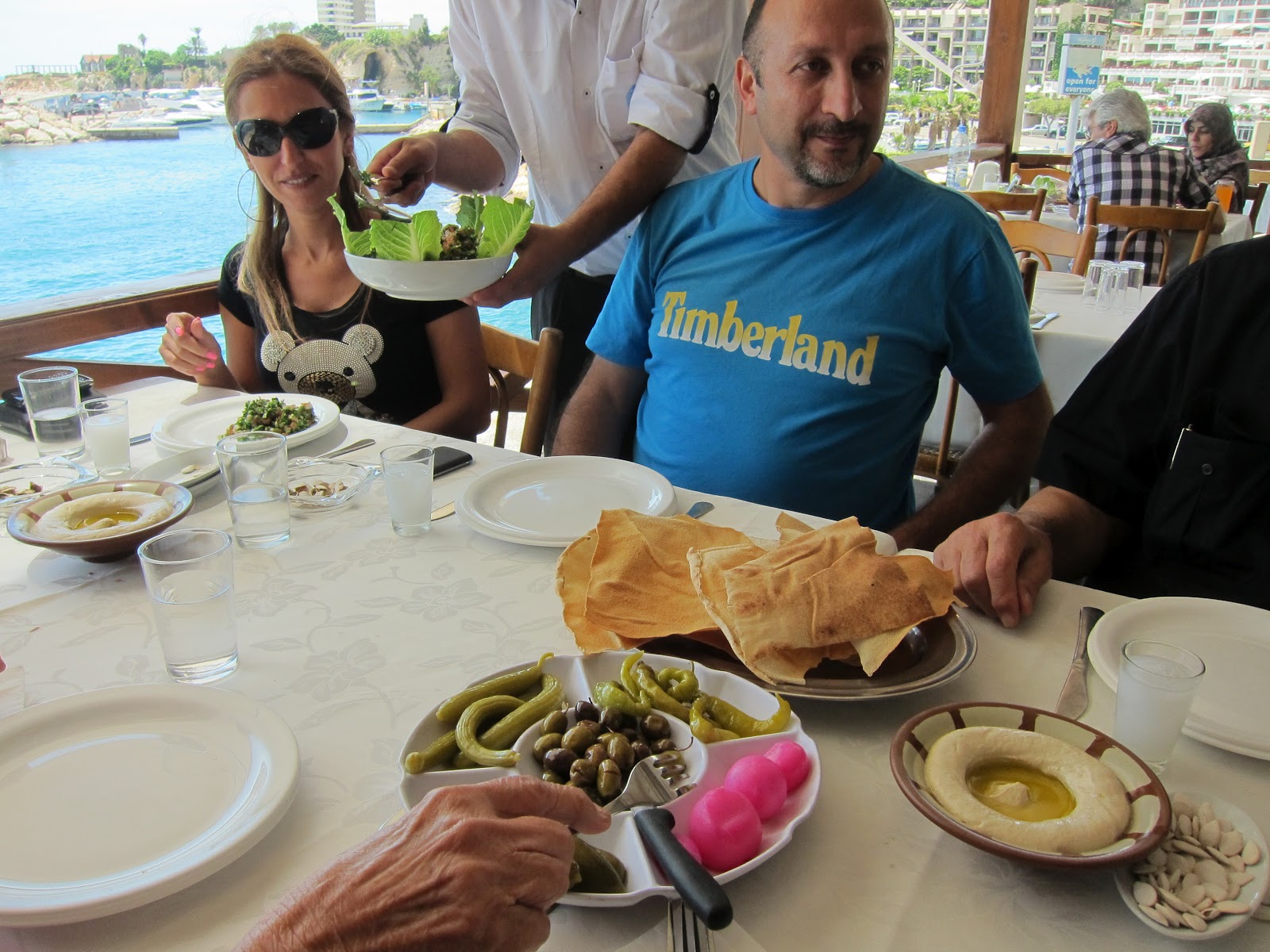
Eating out in Lebanon is a serious endeavor. Friends and families gather around the table and spend hours sampling a multitude of small dishes called mezze (hummus, baba ganouj, olives, pickled vegetables,cheeses, raw meat...), tabbouleh and fattoush.
 |
| Fresh vegetable platter |

 |
| Raw platter of kibbeh, kifta, lamb fat, liver and tenderloin |


Later on the main course is served. Dessert usually consists of a bounty of fresh fruit. Although a wide variety of sweets are made and sold throughout the country, they are usually not the preferred dessert course but rather a snack with tea or coffee. Dinner usually ends with a delicious cup of Turkish coffee served (at restaurants) by coffee boys wearing the traditional outfit of shirwal (a long skirt that gathers in the middle to form a sort of pant with a deep seat and tapered legs), white shirt with colorful embroidered vest and a tarboosh (Lebanese version of a fez). Christians usually drink either whiskey or the traditional araq (anise flavored liquor diluted with water) with their meals.
 |
| Dessert of fresh fruit, sweets and candied fruit |

Restaurant food tends to be rather predictable. Usually a wide variety of rather standard mezze is first served followed by the entrées that usually consist of grilled meats (lamb kabobs) and grilled chicken with garlic sauce. Seafood restaurants substitute the meat for grilled and deep fried fish accompanied by a tahini sauce.

 |
| Fried smelt, tabbouleh, labne (fresh yogurt cheese), garlic sauce |
 |
| Fried red mullet |

 Another day we head to a restaurant I saw featured on a travel show while at home. The place, called Tawlet al Souq al Taeb, is actually a restaurant space where housewives from different villages throughout the country come to cook their local specialties. The menu changes daily and consists of a large buffet where one is free to eat as much as you want. Araq, lemonade, desserts and coffee is included in the 22000 Lebanese pound cost (around $15). Today we are lucky that the chef is from the region of Ehden, famous for its kibbeh. The menus consists of several salads, delicious raw kibbeh (pounded goat meat, seasoned with a hint of allspice and mixed with grated, onion and fine bulgur wheat) eaten drizzled with olive oil and accompanied by raw onion and mint leaves, sautéed hindbi (a wild mountain spinach) with burned onions, several stews including a delicious artichoke hearts and lamb stew, and a multitude of side dishes. This ranked very high in my culinary experience in Lebanon.


chickpeas cooked with garlic and lemon juice, drizzled with olive oil). It was served with tomatoes and mint leaves and accompanied by pickled vegetables, green olives and homemade bread. My cousin ordered a bowl of fatte while my aunt got some hummus. The beans were perfectly cooked and seasoned. The juicy ripe tomatoes and the cool fresh mint leaves provided the right balance to the warm, thick garlicky stew.
Although we visited many excellent restaurants during my two week stay, the best meals were definitely home cooked.
Home cooked meals are usually much simpler. Salads are usually part of the meal but a plate of fresh vegetables is always present (small local cucumbers, sweet radishes, sweet white onions and the local thin-skin, red and green hued tomato). Main courses are usually stews, stuffed vegetables ( small zucchini, small eggplants, cabbage leaves, grape leaves, chard leaves and even hollowed out potatoes), rice dishes, kibbehs or even hardy soups. Thin bread is always plentiful. Large quantities of fruit is always present as dessert.
One of my favorite meals is rice with chicken. Chicken pieces are steamed in a cinnamon broth and then deboned. Rice is then cooked in rich butter, mixed with spiced ground meat and mixed with the previously steamed and shredded chicken. The whole thing is the put on a plater in a steaming heap and covered with a mixture of pine nuts and almonds fried in more butter. This is usually eaten accompanied by "fatteh", fried strips of flat bread covered with a layer of tart yogurt and topped with pine nuts cooked in brown butter. Probably a calorie bomb but oh so delicious.
At home we did also eat some mezze before a much simpler main course. Olives, cheeses, pickled vegetables...
 |
| Shanklish with zaatar and olive oil, radishes and bread |

 |
| Grilling kibbehs for lunch |
Grilled meats are always a favorite weekend meal: lamb skewers, kiftas ( ground lamb spiced with chopped onions, and mint leaves), chicken. a thick garlic aioli is usually mixed with pomegranate molasses and served with the meat.


On one occasion after we had feasted at a restaurant for lunch, dinner consisted of sautéed chicken livers, hearts and gizzards with pomegranate molasses. Once the meat browns, the molasses is drizzled over the mixture while still on the stove. It caramelizes over the meat and imparts a delicious tart yet fruity note to the dish.
 At a cousin's home we were treated to a plater of baked kiftas (ground lamb mixed with minced onion and mint and shaped either as a patty or as a long kabob) with potatoes and tomatoes. Once again the mixture was seasoned with salt, some allspice and drizzled with olive oil and the ubiquitous pomegranate molasses before being baked in the oven. Although the dish is usually arranged in layers starting with the meat at the bottom of the pan, the potatoes in the middle and the tomatoes on top, by the time it is cooked, the potatoes and the tomatoes have caramelized in the oven and soaked in the flavor of the lamb and spices.
On a cool night we ate a delicious meal that consisted of small kibbeh balls stuffed with ground meat and pine nuts ( the kind that is usually fried) cooked in a yogurt soup. The soup was prepared with goat yogurt that is first brought to a boil with the addition of a small handful of rice, a tablespoon of cornstarch and occasionally a whole egg, all meant to keep the yogurt from curdling. Subsequently the kibbeh balls are added to the soup to cook. Garlic and chopped mint is then fried in butter and added to the pot.
We ate many other great stews: fasoolya b zeit (kidney beans stewed with onion and garlic sautéed in olive oil with pomegranate molasses added also to the pot), small white beans stewed with lamb in a rich tomato sauce, tiny okra stewed with lamb and tomatoes. Usually these were accompanied by rice cooked with browned raw vermicelli and butter.
We also visited several sweet shops. The best one was in Tripoli. Abdul Rahman Hallab and sons (www.hallab.com.lb) has been in existence since 1881 serving a wide variety of fresh, delicious sweets: baklavas (filled with pine nuts, pistachios, walnut), znoud as Sit (filled with creamy achtar), basma, knefeh, mafrouke, maamoul, sanyoura...


I left Lebanon happy with my visit, satiated by two weeks of delicious meals, tasty, ripe fruit and rich sweets. I gained a few pounds that I will have to spend the next month shedding but I made memories that will last a lifetime.